


Your hosting provider is the foundation your online store sits on. Get it right, and customers check out without friction. Get it wrong, and slow load times, unexpected downtime, and checkout errors become your problem to solve on a Tuesday night when sales should be coming in.
The difference between a blog and an eCommerce site comes down to what’s actually happening under the hood. Every product page load, every cart update, every payment submission puts a real demand on your server. A host that handles a content site with ease can quietly bottleneck a store doing a few hundred orders per week.
This guide cuts through the noise in the eCommerce hosting comparison space and shows you exactly which providers deliver for small-business online stores in 2026, what sets them apart, and how to pick the right one for where your business actually is right now.
Quick Comparison: Best Web Hosting for Small Business eCommerce 2026
| Host | Starting Price | Platform Support | Best For |
| Hostinger Business | $3.29/mo | WooCommerce, WordPress | Best value, budget stores |
| Bluehost WooCommerce | $6.99/mo | WooCommerce, WordPress | Guided setup, beginners |
| SiteGround WooCommerce | $4.99/mo | WooCommerce, WordPress | Reliability, growing stores |
| Shopify Basic | $29/mo | Shopify (fully managed) | Managed, no-host-needed |
| DreamHost | $7.99/mo | WooCommerce, WordPress | Flexibility, no contract |
What Makes eCommerce Hosting Different from Regular Hosting
Before comparing providers, it helps to understand what you’re actually paying for when you buy eCommerce-specific hosting rather than a standard shared plan.
Three Technical Requirements That Actually Matter
PHP workers are the first thing most guides skip. These handle simultaneous PHP requests on your server. A blog needs one or two. A small online store handling multiple visitors checking out at the same time needs five to ten. Without enough PHP workers, your checkout process queues up, and customers bail before they finish paying.
Object caching via Redis or Memcached is the second. Without it, every product page forces your server to query the database from scratch. With it, repeat queries load from memory in milliseconds. For a store with a product catalog, that difference shows up directly in page speed scores.
SSL and PCI compliance round out the list. SSL is non-negotiable for any reliable hosting for eCommerce, and every host reviewed here includes it free. PCI compliance for card data is typically handled through your payment gateway (Stripe, PayPal, Square), but your hosting environment needs to support it without extra configuration.
Best Web Hosting for Small Business eCommerce in 2026
This eCommerce hosting comparison covers five providers that consistently rise above the noise. Here’s what each one actually delivers and who it’s built for.
Hostinger Business

If you’re looking for the best hosting for online store setups at the lowest cost, Hostinger Business is where the conversation starts. At $3.29 to $3.49 per month, it delivers NVMe SSD storage, LiteSpeed Enterprise servers, LSCache object caching, five to ten PHP workers, and one-click WooCommerce installation.
The Business plan supports 50 websites, 100GB NVMe storage, a free domain for year one, daily backups, and Cloudflare CDN. For hosting for WooCommerce sites, it covers the full requirement stack without any paid optimization plugins.
Best for: New stores, dropshippers, and small businesses doing under $5,000 per month.
Bluehost WooCommerce Hosting
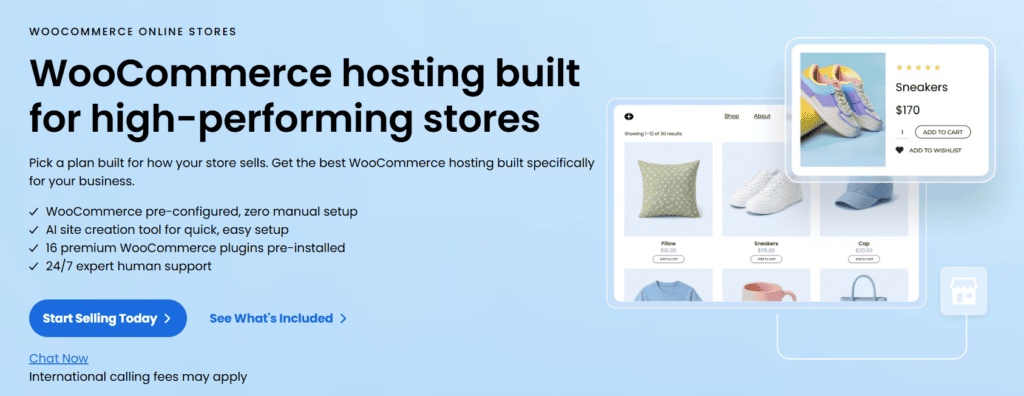
Bluehost is one of three hosts officially recommended by WordPress.org. WooCommerce comes pre-installed with a storefront theme, YITH premium plugins, and a beginner-friendly onboarding flow.
The eCommerce Essentials plan at $6.99 per month includes free SSL, DDoS protection, malware scanning, automatic backups, and Stripe and PayPal pre-configured. For any small business website hosting situation where the owner wants to focus on selling rather than server setup, Bluehost is the most polished starting point in this category.
Note: business email is not included by default. Factor in that add-on cost before comparing plans.
Best for: First-time store owners who want a pre-configured WooCommerce environment.
SiteGround WooCommerce Hosting

SiteGround runs on Google Cloud infrastructure, putting it in a different performance tier than most shared hosts. Its WooCommerce plan at $4.99 per month includes free SSL, daily backups, a staging environment, and unlimited email. The GrowBig plan handles around 100,000 monthly visits before you need to upgrade.
In any eCommerce hosting comparison, SiteGround stands out on support. Its team is specifically trained on WooCommerce, which matters when a checkout error surfaces on a Friday night. The caveat: renewal rates jump significantly, sometimes four to five times the intro price. Plan for it before you sign.
Best for: Growing stores that prioritize Google Cloud reliability and WooCommerce-specific support.
Shopify

Shopify is not a traditional web host. It’s a fully managed eCommerce platform where hosting, SSL, payments, and security are bundled into a single subscription. Plans start at $29 per month, with 99.99% uptime and a global CDN included.
The cost trade-off against hosting for WooCommerce sites is real. Shopify Basic charges a 2% transaction fee on non-Shopify gateways. On 100 orders averaging $50, that’s $100 per month in platform fees before any apps. For hosting for Shopify sites, you’re paying for managed convenience. If that simplicity is worth the premium, it is a legitimate choice.
Best for: Owners who want everything managed in one place with zero hosting decisions.
DreamHost WooCommerce Hosting
DreamHost is the strongest, most reliable hosting for eCommerce pick for stores not ready to commit long-term. Month-to-month pricing starts at around $7.99 per month with unlimited traffic, SSD storage, free SSL, a free domain for year one, and WooCommerce support built in.
Its 97-day money-back guarantee is the longest on this list, giving early-stage stores a genuine evaluation window before locking in.
Best for: Early-stage stores that want flexibility without a multi-year contract.
What to Check Before You Buy?
Even the best web hosting for small business eCommerce comes with trade-offs you won’t see in the headline plan description.
Renewal rate:
Every host on this list uses introductory pricing. Check what the plan costs after year one before you sign. A $3.49/month intro rate that renews at $14.99 is not a $3.49 product. It’s a two-year average cost of roughly $9.
PHP worker allocation:
Ask or check the plan page specifically for PHP worker count before committing to any shared hosting plan for your store. If the plan page doesn’t mention it, that’s a red flag for eCommerce use cases.
Staging environment:
Any store making regular product or design updates needs a staging environment to test changes before they go live. SiteGround and Bluehost include it. Hostinger’s staging is available on higher-tier plans. Shopify includes it on mid-tier plans and above.
Payment gateway compatibility:
Every host reviewed here supports Stripe and PayPal integration. If you plan to use a regional or niche gateway, confirm compatibility before you build your catalog.
The Bottom Line
The best web hosting for small business eCommerce in 2026 is not one answer for everyone. It’s the host that matches where your store is today and where it’s realistically going in the next twelve months.
For maximum value on a WooCommerce store: Hostinger Business. For the most beginner-friendly WooCommerce experience: Bluehost. For cloud-backed reliability and top-tier support: SiteGround. For a fully managed experience with no hosting management: Shopify. For month-to-month flexibility: DreamHost.
Pick the one that fits your real situation, check the renewal pricing before you sign, and spend the rest of your time building the store, not managing the server.







Leave feedback about this