

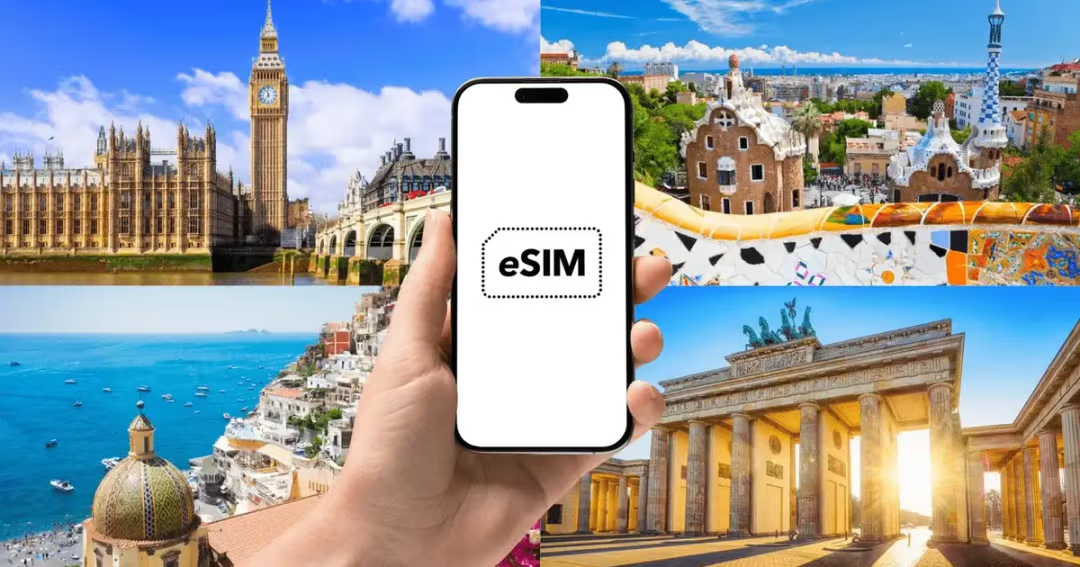
Traveling across Europe can mean moving between several countries within a single trip. You might start in France, continue to Switzerland, take a train into Italy, and finish in Spain. While crossing borders can be simple for travelers, staying connected throughout the journey requires a little more planning.
Using international roaming through your home carrier is one option, but the cost and conditions can vary. Buying a separate local SIM in every country is another possibility, but it becomes inconvenient when the itinerary includes several destinations.
A regional travel eSIM can simplify the process. Instead of purchasing a separate SIM or eSIM for every country, you can choose one plan designed to work across multiple European destinations. The best travel eSIM for multiple countries in Europe should offer suitable country coverage, enough data for your usage, a useful validity period, and straightforward activation.
Why Use an eSIM for Multi-Country Travel in Europe?
A travel eSIM can be particularly useful when your European itinerary includes several countries. With a compatible and unlocked smartphone, an eSIM can be installed digitally without removing your existing physical SIM. This means you can keep your regular SIM available while using the travel eSIM for mobile data.
The biggest advantage for multi-country travel is the possibility of using a regional plan across several destinations. Instead of purchasing a new connection whenever you cross a border, one regional eSIM can continue providing data in the countries included in the plan.
This can also make trip preparation easier. You can purchase and install the eSIM before leaving home and configure your phone to use it for mobile data when you arrive.
However, not every European eSIM covers the same destinations. Some plans cover a limited group of countries, while others include a much broader European list. Checking the exact coverage before purchasing is therefore essential.
What to Look for in a Europe Travel eSIM
Choosing an eSIM for Europe is not simply about finding the cheapest plan. A low-cost plan may not be useful if it does not cover every country on your itinerary.
Country Coverage
Country coverage should be the first consideration for a multi-country European trip. Make a list of every country you plan to visit and compare it against the provider’s coverage list. This is especially important if your itinerary includes destinations outside the most commonly visited European countries.
For example, an itinerary covering France, Germany, Italy, Spain, Switzerland, and the United Kingdom requires a plan that specifically supports all six destinations. Do not assume that a plan labeled “Europe” automatically includes every European country.
Data Allowance
Your data requirements depend on how you use your phone. Basic activities such as messaging, navigation, email, translation, and occasional browsing generally require less data than video streaming, frequent video calls, social media uploads, or hotspot use.
A traveler who spends most of the day sightseeing may need mobile data for maps and transportation apps but can use hotel Wi-Fi for larger downloads. Another traveler working remotely may require substantially more data. Choose an allowance based on your expected usage rather than automatically selecting the largest available package.
Validity Period
Check how long the plan remains active. A seven-day plan may be suitable for a short city break but not for a three-week European vacation. Some providers offer several validity options, while others structure plans differently.
Also check when the validity period starts. Depending on the provider, installation and activation may occur at different stages.
Regional vs Country-Specific Plans
For a single destination, a country-specific eSIM may be enough. For a multi-country itinerary, a regional plan is usually more convenient because it can provide coverage across multiple included destinations.
A regional plan can also reduce the need to manage multiple eSIM profiles. Instead of switching between plans every time you cross a border, you can use the same regional connection where coverage is available.
Network Coverage
The eSIM provider generally connects travelers through local mobile networks rather than operating its own cellular infrastructure in every country. This means performance can vary depending on local network availability, coverage, congestion, and geography.
Check whether the provider supports 4G, LTE, or 5G where available and whether multiple local networks can be accessed in a particular destination.
Activation and Setup
A straightforward installation process matters when you are traveling between countries. Ideally, you should be able to install your eSIM before departure and activate or connect it according to the provider’s instructions when you arrive.
You should also know which settings need to be enabled. Depending on the provider, data roaming may need to be enabled for the travel eSIM while remaining disabled on your primary SIM.
Hotspot Support
If you are traveling with a laptop, tablet, or another phone, hotspot support can be useful. Check the provider’s terms before relying on tethering. Some travel eSIMs allow hotspot use, while others may limit or exclude it.

Best Travel eSIMs for Europe
Several established eSIM providers offer European regional plans. Their coverage, pricing, data allowances, and terms differ, so the right option depends on your itinerary and usage.
| Provider | Europe Coverage | Plan Approach | Useful For |
| Saily | 35 European countries | Fixed-data and unlimited options | Travelers wanting a simple regional eSIM |
| Airalo | 41 European countries on its Europe regional offering | Regional data packages | Multi-country travelers wanting broad European coverage |
| Holafly | 33 countries on its Europe plan | Unlimited-data focused | Travelers expecting high data usage |
| Nomad | European regional options | Destination and regional plans | Travelers comparing different data packages |
| Ubigi | European continental and country options | Regional and local plans | Travelers looking for European or country-specific connectivity |
Coverage and plan terms can change, so travelers should verify the exact package before purchasing.
Saily Europe eSIM: What Does It Offer?
Saily currently offers a Europe regional eSIM covering 35 countries. Its Europe plans include data options ranging from 1 GB to 50 GB, as well as an unlimited option. The available validity periods vary by plan.
The current Europe offering includes destinations such as France, Germany, Italy, Spain, Switzerland, Portugal, the Netherlands, Greece, Austria, Norway, Sweden, the United Kingdom, and Turkey. The provider lists 35 destinations in total, so travelers should check the country list against their specific itinerary.
Saily’s regional plan can automatically activate when the traveler arrives in the first included country, provided the eSIM has been enabled in the device settings and the required roaming setting is turned on. The eSIM can be installed before departure, which allows travelers to prepare their connection while they still have reliable internet access.
Saily also states that its European plans support 3G, 4G, LTE, and 5G depending on local network availability. Its Europe offering supports hotspot sharing and allows users to purchase additional data through the app.
The service is data-only, so conventional cellular calls and SMS are not included. Travelers can instead use internet-based communication services such as WhatsApp, Viber, or Signal.
Airalo Europe eSIM
Airalo offers a regional Europe eSIM that currently lists coverage across 41 countries and networks. It also provides local, regional, and global eSIM options, giving travelers different ways to structure their connectivity.
The Europe option is designed for travelers moving between multiple European destinations without purchasing a separate eSIM for each country.
Airalo’s regional offering can therefore be useful for itineraries that involve several countries. However, travelers should still review the exact country list and plan conditions before purchase, particularly when their itinerary includes destinations that are sometimes treated separately from mainland Europe.
Holafly Europe eSIM
Holafly offers a Europe regional eSIM focused on unlimited-data plans. Its current Europe offering lists 33 included countries.
This type of plan may appeal to travelers who expect to use significant amounts of mobile data for video calls, social media, streaming, navigation, and other activities.
However, travelers should check the specific plan conditions before purchasing an unlimited package. Network performance and coverage can vary by destination, and hotspot or fair-use conditions may apply depending on the plan.
Nomad Europe eSIM
Nomad offers travel eSIM options for multiple destinations and regions, including Europe.
Its approach allows travelers to compare destination-specific and regional options according to their itinerary. This can be useful if a traveler is visiting several European countries but does not need a broader global plan.
As with any regional eSIM, check that every destination on your itinerary is included before purchasing.
Ubigi Europe eSIM
Ubigi offers both European continental plans and country-specific options. Its European coverage allows travelers to use one data plan while moving between different European countries. It also provides local plans for destinations including France, Germany, Italy, Spain, the United Kingdom, and Switzerland. This gives travelers flexibility when deciding between a regional plan and a country-specific package.

Europe eSIM Comparison: Which Type Fits Your Trip?
The most useful way to compare European eSIMs is to consider the type of trip you are taking.
| Trip Type | What to Prioritize | Suitable Plan Type |
| One-country vacation | Price, data, validity | Country-specific eSIM |
| 2–3 European countries | Coverage and validity | Regional eSIM |
| 4+ countries | Broad coverage | European regional eSIM |
| Long European trip | Data and validity | Larger regional plan |
| Heavy data usage | High or unlimited allowance | Large/unlimited plan |
| Light data usage | Low-cost data package | Small fixed-data plan |
This approach prevents you from paying for features you do not need. For example, someone spending five days in Paris may not need a large European regional package. A traveler spending three weeks moving through France, Italy, Austria, and Germany may benefit from one regional plan that covers the entire itinerary.
Regional Europe eSIM vs Individual Country eSIMs
The choice between a regional and country-specific eSIM depends largely on your itinerary. A country-specific eSIM can be economical when you are staying in one destination. There is little reason to purchase broad regional coverage if you are spending your entire trip in one country.
A regional eSIM becomes more practical when you are crossing borders. Consider a traveler visiting France, Belgium, Germany, Italy, and Spain. Purchasing separate plans for every destination means managing several plans and potentially switching between them.
A regional eSIM can simplify that process by providing coverage across multiple included countries. The important caveat is coverage. Always compare the provider’s current country list with your complete itinerary.
How Much Data Do You Need in Europe?
There is no fixed amount of data that every traveler needs.
Light Data Users
If you mainly use messaging, maps, email, translation, and occasional browsing, a smaller plan may be sufficient. Downloading offline maps and travel information before your trip can reduce mobile data consumption further.
Moderate Data Users
Moderate users may regularly use social media, navigation, restaurant searches, ride-hailing apps, and photo uploads. A medium-sized data plan can provide more flexibility without requiring an unlimited package.
Heavy Data Users
Heavy users may stream videos, make frequent video calls, upload large files, or use their phone as a hotspot.
For these travelers, a large or unlimited plan may be worth considering. However, check the provider’s terms before assuming that an unlimited plan means unrestricted use under every circumstance.
How to Set Up a Europe Travel eSIM
Setting up your eSIM before your trip can make the arrival process easier.
Step 1: Check eSIM Compatibility
Confirm that your smartphone supports eSIM technology. Also check that your device is unlocked. A carrier-locked phone may prevent you from using a travel eSIM from another provider.
Step 2: Choose Your Europe Plan
Review the countries you are visiting and select a plan that covers every destination. Then compare data allowance and validity against the length of your trip.
Step 3: Install the eSIM Before Departure
Installing the eSIM before leaving home means you can complete the setup while connected to reliable Wi-Fi. Saily provides an installation process through its app and also provides a QR code when a plan is purchased through its website.
Step 4: Select the eSIM for Mobile Data
When you arrive in Europe, select the travel eSIM as the mobile data line. If you are keeping your regular SIM active for calls or messages, make sure your phone does not automatically switch mobile data back to your primary line.
Step 5: Check the Connection
Once connected, open a website or app to confirm that mobile data is working. If it does not connect immediately, check the eSIM settings, supported network selection, and activation requirements provided by your provider.
Using an eSIM Across Multiple European Countries
One of the main advantages of a regional eSIM is that you do not necessarily have to change your data plan every time you cross a border. Suppose your itinerary is:
France → Switzerland → Italy → Austria → Germany
If all five destinations are included in your regional plan, the same eSIM can continue providing mobile data as you travel. However, coverage does not mean that performance will be identical everywhere.
Your connection can change depending on the local network, geography, congestion, and whether you are traveling through rural or mountainous areas. Before crossing into another country, it is also worth checking that the destination is included in your plan.
How to Avoid Roaming Charges in Europe
Having a travel eSIM does not automatically prevent your primary SIM from generating roaming charges. Your phone can still connect your regular SIM to a foreign network if its settings allow it. To reduce the risk of accidental roaming:
- Select the travel eSIM for mobile data.
- Disable data roaming on your primary SIM.
- Turn off automatic mobile data switching where applicable.
- Check which line is being used for mobile data.
- Monitor your travel eSIM’s data usage.
- Use Wi-Fi for large downloads when convenient.
If you need to keep your regular number active for incoming calls or texts, you may be able to leave the primary SIM enabled while preventing it from being used for mobile data. The exact settings depend on your phone.
Is a Europe Travel eSIM Worth It?
A Europe travel eSIM can be useful when your trip involves multiple countries, and you want to avoid repeatedly changing physical SIM cards or purchasing separate connections. It can be particularly convenient for:
- Multi-country European vacations
- Backpacking trips
- Train journeys across Europe
- Business travel across several countries
- Short trips where buying local SIMs is inconvenient
- Travelers who want to prepare their connection before departure
The main things to verify are compatibility, coverage, data allowance, validity, network access, hotspot rules, and activation requirements.
For travelers whose itinerary includes several of the 35 European destinations currently covered by Saily, its regional Europe eSIM is one option to consider. The current offering includes multiple fixed-data sizes and an unlimited option, with plan durations varying according to the package.
Final Thoughts
Choosing the best travel eSIM for Europe multiple countries starts with your itinerary rather than the provider name.
First, list every country you plan to visit. Then compare regional coverage, data allowance, validity, network availability, activation, and hotspot support. A small country-specific plan may be enough for a single destination, while a regional eSIM can simplify connectivity when your trip crosses several borders.
Saily, Airalo, Holafly, Nomad, and Ubigi all offer European travel eSIM options, but their coverage and plan structures differ. Current offerings show that even providers using the same “Europe eSIM” label can cover different numbers of countries, so checking the exact destination list remains important.
For most multi-country travelers, the goal is simple: choose one compatible eSIM that covers the entire itinerary, provides enough data for your daily activities, and can be installed before the journey begins. That preparation can make crossing European borders much easier without having to search for a new SIM every time you enter another country.







Leave feedback about this